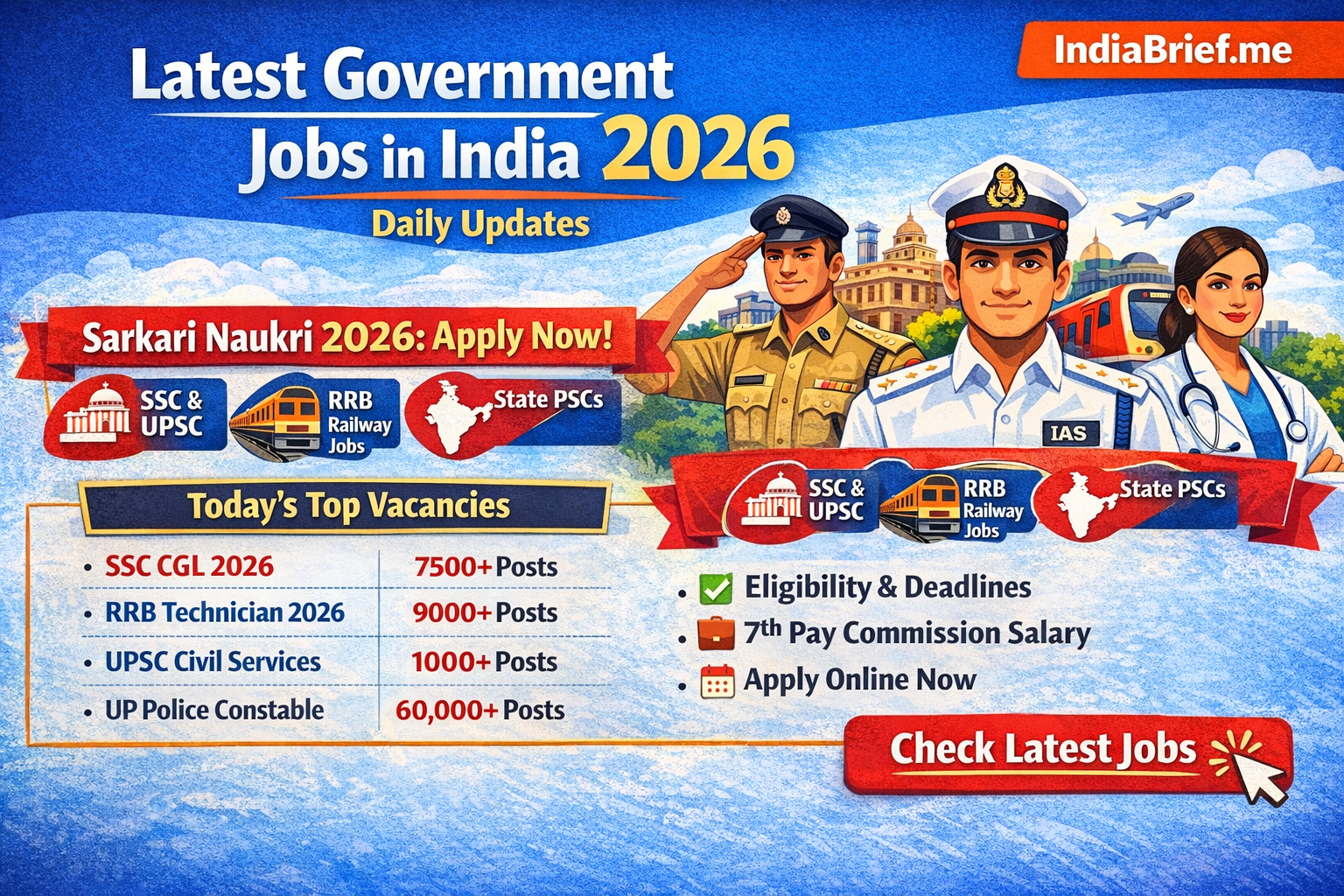
Quick Answer ✅ In 2026, thousands of government job vacancies are open across India through SSC, UPSC, RRB, and state PSCs. Openings exist for candidates from 10th pass to graduates. Departments like Railways, Defence, Banking, and Police are actively recruiting. Check official portals like ssc.gov.in, upsc.gov.in, and indianrailways.gov.in for the latest notifications and deadlines.
Article Summary
India’s central and state governments are actively releasing recruitment notifications in 2026 across departments including Railways, Defence, Banking, Police, Teaching, and Public Sector Undertakings (PSUs). Major recruiting bodies — the Staff Selection Commission (SSC), Union Public Service Commission (UPSC), Railway Recruitment Board (RRB), and various State Public Service Commissions (PSCs) — are filling posts ranging from Group C and Group D roles (suitable for 10th/12th pass candidates) to Group A gazetted officer posts (requiring graduation or postgraduation). Application processes are online via official government portals. Salary structures follow the 7th Pay Commission recommendations. This article is your single daily-updated hub — organised by qualification, department, and deadline — so you never miss a sarkari naukri 2026 opportunity.
Why Latest Government Jobs in India 2026 Are the Biggest Opportunity Right Now
Every year, millions of Indians compete for government jobs — and 2026 is shaping up to be one of the most active recruitment years in recent memory. Multiple large-scale drives have been announced or are expected across central and state governments.
Why do government jobs matter so much? Job security, pension benefits, healthcare, housing allowances, and pay scales under the 7th Pay Commission make a sarkari naukri one of the most sought-after career outcomes for Indian families.
According to the Ministry of Personnel, Public Grievances and Pensions, the Indian government employs approximately 3.2 million civilian central government employees (Source: Annual Report, Department of Expenditure, Government of India). Every year, retirements and new department expansions create fresh vacancies — and 2026 is no exception.
Whether you are a 10th-pass candidate from a Tier 3 town or a postgraduate from a metro city, there is a govt job vacancy 2026 that matches your profile. This article covers them all — organised clearly so you can act fast.
Section 1 — Overview: What Is Sarkari Naukri 2026 and Who Is Recruiting?
Sarkari naukri (Hindi for “government job”) refers to employment under the central or state government of India, including Public Sector Undertakings (PSUs), autonomous bodies, and constitutional organisations.
In 2026, recruitment is happening at three levels:
- Central Government — SSC, UPSC, RRB, IBPS, and Defence ministries
- State Government — State PSCs, State Police Departments, State Education Boards
- PSUs & Autonomous Bodies — NTPC, BHEL, ONGC, DRDO, HAL, and similar organisations
Who Are the Major Recruiting Bodies in 2026?
| Recruiting Body | Full Name | Types of Posts | Official Portal |
|---|---|---|---|
| SSC | Staff Selection Commission | MTS, CHSL, CGL, GD Constable | ssc.gov.in |
| UPSC | Union Public Service Commission | IAS, IPS, IFS, CDS, CAPF | upsc.gov.in |
| RRB | Railway Recruitment Board | NTPC, Group D, ALP, JE | indianrailways.gov.in |
| IBPS | Institute of Banking Personnel Selection | PO, Clerk, SO, RRB | ibps.in |
| State PSCs | State Public Service Commissions | SDO, Tehsildar, Block Officer | State-specific portals |
| DRDO | Defence Research & Development Organisation | Scientist, JRF, RAC posts | drdo.gov.in |
Why 2026 Is a Big Year for Govt Job Vacancies
Multiple large recruitment cycles that were delayed post-COVID have matured into active notifications. The Government of India’s push for Agnipath, Smart Cities, and Digital India programmes has also created new categories of technical roles.
Pro Tip 💡: Always check the official body’s website directly. Third-party sites may have outdated or incorrect information. Bookmark ssc.gov.in, upsc.gov.in, and your State PSC portal today.
Takeaway: Whether you want a central or state government posting, 2026 has options for nearly every educational qualification level.
Section 2 — Key Vacancies: Latest Govt Job Notifications in 2026 (with Official Data)
Below is a summary of major active or recently announced recruitment notifications. Always verify deadlines and vacancy counts on the official portal before applying, as these are subject to revision.
Central Government Jobs 2026 — Active Notifications
| Board/Body | Post Name | Approximate Vacancies | Qualification | Official Source |
|---|---|---|---|---|
| SSC | SSC GD Constable 2025–26 | As per official CEN (check ssc.gov.in) | 10th Pass | ssc.gov.in |
| SSC | SSC CHSL 2026 | As per official notification | 12th Pass | ssc.gov.in |
| SSC | SSC CGL 2026 | As per official notification | Graduate | ssc.gov.in |
| RRB | RRB NTPC 2026 | As per CEN (check indianrailways.gov.in) | Graduate/12th | indianrailways.gov.in |
| UPSC | Civil Services Examination 2026 | ~1,000+ (varies by year) | Graduate | upsc.gov.in |
| IBPS | IBPS PO/Clerk 2026 | As per official CRP notification | Graduate | ibps.in |
| Indian Army | Agniveer 2026 | Multiple batches (check joinindianarmy.nic.in) | 10th/12th | joinindianarmy.nic.in |
⚠️ Important Note: Exact vacancy numbers are released through official CEN (Centralised Employment Notification) or recruitment advertisements. The table above lists post categories confirmed to be recurring annual recruitments. Check the respective official portal for the exact 2026 notification numbers before applying.
State Government Jobs 2026 — Key Highlights
State-level recruitment is equally active. Here are major states with ongoing or upcoming drives (as per available reports):
- Uttar Pradesh (UPPSC / UP Police) — Regular openings for sub-inspectors, constables, PCS officers
- Rajasthan (RPSC) — Teacher vacancies and administrative officer posts
- Maharashtra (MPSC) — Group A/B posts and State Police recruitment
- Tamil Nadu (TNPSC) — Group 1, 2, 4 exams scheduled in 2026
- Bihar (BPSC) — Integrated exam for various posts announced
- Madhya Pradesh (MPPSC) — State service and forest department vacancies
Pro Tip 💡: Each state PSC publishes its annual recruitment calendar in January. Visit your state PSC website and download the Annual Exam Calendar 2026 — it’s the single most important document for planning your prep year.
Takeaway: Both central and state govt vacancies in 2026 are substantial. Candidates should identify their target posts early and prepare accordingly.
Section 3 — Eligibility & How to Apply: Step-by-Step Guide for Sarkari Naukri 2026
Understanding the process is half the battle. Here is a simple step-by-step guide applicable to most central government recruitment processes.
Who Can Apply? Eligibility Criteria by Qualification
| Qualification | Eligible Posts | Age Limit (General) |
|---|---|---|
| 10th Pass (Matriculation) | SSC MTS, Railway Group D, Army Agniveer, Multi-Tasking Staff | 18–25 years (varies) |
| 12th Pass (Intermediate) | SSC CHSL, RRB NTPC (some posts), Agniveer | 18–27 years (varies) |
| ITI / Diploma | Railway ALP, Technician posts, PSU technicians | 18–30 years (varies) |
| Graduate (Any Stream) | SSC CGL, IBPS PO/Clerk, RRB NTPC Graduate posts | 20–30 years (varies) |
| Postgraduate / Law | UPSC Civil Services, Judiciary, Specialist Officer posts | 21–32 years (varies) |
Note: Age relaxation is provided for SC/ST (5 years), OBC (3 years), PwD (10 years), and Ex-Servicemen as per government norms.
Step-by-Step Application Process (Central Government Jobs)
- Find the Official Notification — Visit the official recruiting body’s website (e.g., ssc.gov.in). Download the full PDF notification.
- Read the Notification Carefully — Check eligibility, vacancies per post, pay scale, exam pattern, and important dates.
- Register on the Official Portal — Create a one-time registration using your mobile number and email ID.
- Fill the Online Application Form — Enter personal details, educational qualifications, and choose your exam centre preference.
- Upload Documents — Photograph (passport size), signature, and caste/disability certificate (if applicable) in specified format and size.
- Pay the Application Fee — Fee is usually ₹100–₹200 for most SSC/RRB exams. SC/ST/PwD/Women candidates are often exempt.
- Download the Admit Card — Released 2–4 weeks before the exam on the official portal. Required for entry to the exam hall.
- Appear for the Exam — Computer-Based Test (CBT) or Offline OMR sheet, depending on the post.
- Check the Result — Published on the official website. Shortlisted candidates proceed to next stages (document verification, physical test, interview as applicable).
- Document Verification & Final Joining — Submit original documents at the designated centre. Receive posting order.
Takeaway: The application process is fully online for most central government jobs. A stable internet connection, a valid email ID, and scanned documents are all you need to get started.
Section 4 — Salary, Pay Scale & Benefits: What Will You Actually Earn?
One of the biggest draws of govt job vacancy 2026 is the structured pay scale and non-monetary benefits. Here is what you can expect.
Salary Structure Under the 7th Pay Commission
The 7th Central Pay Commission (7th CPC) recommendations govern salary for central government employees. The pay matrix ranges from Level 1 to Level 18.
| Post Category | Pay Matrix Level | Basic Pay Range | Gross Salary (Approx.) |
|---|---|---|---|
| Group D (MTS, Peon) | Level 1 | ₹18,000 | ₹22,000–₹28,000/month |
| Group C (LDC, Clerk, Constable) | Level 2–4 | ₹19,900–₹25,500 | ₹28,000–₹40,000/month |
| Group B (SSC CGL Tier posts) | Level 5–8 | ₹29,200–₹47,600 | ₹45,000–₹75,000/month |
| Group A Gazetted (IAS/IPS/IFS) | Level 10+ | ₹56,100 and above | ₹80,000–₹2,50,000+/month |
(Source: 7th Central Pay Commission Report, Government of India — pay.gov.in)
Non-Monetary Benefits (Why These Are Worth More Than You Think)
- Dearness Allowance (DA) — Updated twice yearly; currently a significant percentage of basic pay
- House Rent Allowance (HRA) — 8% to 27% of basic pay depending on city classification
- Medical Benefits — CGHS (Central Government Health Scheme) for employee and family
- Pension — National Pension System (NPS) for new recruits; defined benefit pension for some legacy posts
- Leave — Earned Leave, Medical Leave, Maternity/Paternity Leave, Study Leave
- Job Security — Virtually no layoffs for confirmed government employees
Takeaway: A Group C government job with all allowances can provide a monthly take-home of ₹35,000–₹50,000 — far exceeding many private sector roles at the same qualification level in Tier 2/3 cities.
Section 5 — Expert Analysis: How to Choose the Right Govt Job for YOU in 2026
With so many options available, many candidates waste years preparing for the wrong exam. Here is a practical framework to choose wisely.
Match Your Qualification to the Right Exam
If you are a 10th pass candidate, focus on:
- SSC Multi-Tasking Staff (MTS) Examination
- Railway Group D (RRB Group D)
- Indian Army Agniveer (Enrolment)
- State Police Constable Vacancies
If you are a 12th pass candidate, aim for:
- SSC Combined Higher Secondary Level (CHSL) Exam
- RRB NTPC (Non-Technical Popular Categories — 12th pass posts)
- IBPS Office Assistant (RRB Clerk)
- State Level Police and Revenue Department openings
If you are a graduate, target:
- SSC Combined Graduate Level (CGL) Exam
- UPSC Civil Services / CDS / CAPF
- IBPS PO (Probationary Officer)
- RRB NTPC Graduate posts
- PSU recruitment (NTPC, BHEL, ONGC, GAIL)
How Competitive Are These Exams? (Rough Benchmark)
| Exam | Approximate Applicants | Approximate Selection Rate |
|---|---|---|
| UPSC Civil Services | ~10 lakh+ | ~0.1% |
| SSC CGL | ~30 lakh+ | ~0.3%–0.5% |
| RRB NTPC | ~1–2 crore | ~0.5%–1% |
| IBPS PO | ~10 lakh+ | ~0.5%–1% |
| State PSC (varies) | Varies widely | ~0.5%–2% |
(Note: Figures are approximate based on publicly reported past cycles. Check official result data for precise numbers.)
Takeaway: Competition is high, but not impossible. Consistency, the right resources, and a structured study plan are what separate successful candidates from the rest.
Section 6 — 5 Common Myths About Government Jobs in 2026 — BUSTED
Many candidates hold back from applying due to misconceptions. Let us clear them up.
Myth 1: “You Need to Know Someone (Sifarish) to Get a Govt Job”
BUSTED. Central government recruitment through SSC, UPSC, and RRB is fully merit-based and computer-based. Answer sheets are evaluated digitally. Final merit lists are based purely on marks. No human interference is possible in the selection pipeline.
Myth 2: “Only Hindi Medium Candidates Struggle in English-Based Exams”
BUSTED. SSC, IBPS, and RRB exams offer bilingual question papers (Hindi + English) for most sections except the English Language paper itself. Many toppers from Hindi-medium backgrounds clear these exams with targeted preparation.
Myth 3: “Age Limit Has Passed, I Can Never Apply”
BUSTED. Many candidates do not realise that age relaxation of 3–10 years is available for OBC, SC/ST, PwD, and Ex-Serviceman categories. Additionally, some posts (like UPSC Civil Services) allow attempts up to age 32 for OBC and 37 for SC/ST. Always re-check the notification.
Myth 4: “Online Coaching Is Too Expensive for Me”
BUSTED. Platforms like Testbook, Adda247, and others offer free daily practice tests, free live classes on YouTube, and affordable subscription plans starting as low as ₹99/month. Serious preparation does not require expensive classroom coaching.
If you want structured, exam-focused preparation with mock tests and previous year papers, Testbook (testbook.com) and Adda247 (adda247.com) are widely trusted by lakhs of government job aspirants across India. Both offer free trials — try before you commit. (Affiliate link placeholder — replace with tracked URL)
Myth 5: “Private Jobs Pay More, So Govt Jobs Are Not Worth It”
BUSTED. When you factor in job security, pension, HRA, DA, CGHS medical cover, annual increments, and zero retrenchment risk — the total compensation package of a Group B government employee often exceeds that of a similar-designation private sector employee in Tier 2/3 cities.
Takeaway: Do not let myths keep you from applying. The system is fairer and more accessible than most people think.
Section 7 — Pro Tips: How to Maximise Your Chances in Sarkari Naukri 2026
Top 8 Insider Tips From Successful Candidates
- Apply Early, Not Last-Minute — Server crashes are common on application deadline days. Apply in the first week of the application window.
- Download Every Notification as a PDF — Official notifications sometimes get revised. Save the original version to track changes.
- Attempt Previous Year Papers First — Do NOT start with new syllabus material. Solving 5 years of previous papers shows you the real pattern.
- Use the Official Mock Test — SSC, RRB, and IBPS provide free official mock tests on their portals. These replicate the exact interface of the real exam.
- Keep Your Documents Ready in Advance — Scanned photo, signature, income certificate, caste certificate (if applicable). Refresh your Aadhaar mobile link. Document issues are the #1 cause of last-minute application failures.
- Track Exam Calendars — SSC releases its Annual Exam Calendar at the start of the year. Download it and mark every exam date, notification date, and application window.
- Join a Peer Study Group — WhatsApp or Telegram groups focused on specific exams help with daily current affairs, answer key discussions, and motivation.
- Do Not Apply for Everything — Spreading prep across 5–6 different exams simultaneously hurts your score in all of them. Pick 2 target exams and go deep.
Pro Tip 💡: Set a Google Alert for “[Exam Name] 2026 notification” so you receive an email the moment a new notification is published. This gives you a head start over candidates who only check portals manually.
How to Apply for SSC CGL 2026 - Complete Guide UPSC Civil Services 2026 - Syllabus, Eligibility and Preparation Strategy RRB NTPC 2026 - Vacancy, Dates and How to Apply
Staff Selection Commission Official Website Union Public Service Commission Official Website Indian Railways Official Recruitment Portal
Frequently Asked Questions (FAQ) — Latest Government Jobs in India 2026
Who can apply for the latest government jobs in India 2026?
Eligibility depends on the specific post. Candidates from 10th pass level to postgraduates can find suitable govt job vacancies in 2026. Most central government exams require Indian citizenship. Age limits typically range from 18 to 32 years for general category candidates, with relaxation for SC/ST (5 years), OBC (3 years), PwD (10 years), and Ex-Servicemen as per government norms.
What are the best government jobs in India for 2026 after the 12th?
The best government jobs for 12th pass candidates in 2026 include SSC CHSL (Staff Selection Commission Combined Higher Secondary Level Examination), RRB NTPC 12th-pass posts, Indian Army Agniveer, and state-level police constable recruitments. These offer competitive salaries starting from ₹19,900 basic pay, strong job security, and clear promotion pathways.
How do I check the latest sarkari naukri 2026 notifications?
Visit official government portals directly: ssc.gov.in for SSC exams, upsc.gov.in for UPSC, indianrailways.gov.in for RRB, and ibps.in for banking jobs. For state jobs, visit your respective State Public Service Commission website. Bookmarking these portals and downloading the annual exam calendar is the most reliable approach. Avoid relying solely on third-party job aggregator websites for deadline information.
What is the salary for central government jobs in 2026?
Salaries for central government jobs in 2026 follow the 7th Pay Commission Pay Matrix. Group D posts start at approximately ₹18,000 basic pay (gross ₹22,000–₹28,000/month). Group C posts range from ₹19,900 to ₹47,600 basic pay. Group A gazetted officer posts (like IAS) start at ₹56,100 basic pay and go significantly higher, with all applicable allowances added on top.
Is there an age limit relaxation for government jobs in India 2026?
Yes. The Government of India provides standard age relaxation across most central recruitment exams: 3 years for Other Backward Classes (OBC), 5 years for Scheduled Castes (SC) and Scheduled Tribes (ST), and 10 years for Persons with Disabilities (PwD). Ex-Servicemen get additional relaxation based on service period. Always check the specific notification for exact relaxation rules applicable to that post.
How long does it take to get a government job after applying in 2026?
The timeline varies by exam and department. A typical recruitment cycle from notification to final joining takes 6 to 18 months for most SSC, RRB, and IBPS exams — covering application, admit card release, exam, result, document verification, and joining formalities. UPSC Civil Services can take up to 12–24 months from notification to final joining due to its multi-stage selection process.
Conclusion: Your Action Plan for Latest Government Jobs in India 2026
Here are your three most important takeaways from this article:
-
2026 is an active recruitment year — SSC, UPSC, RRB, IBPS, and state PSCs are all running or about to announce major recruitment drives. The opportunities are real and numerous.
-
Qualification does not limit you — Whether you are a 10th pass candidate or a postgraduate, there is a suitable latest government job in India 2026 for your profile. Match your qualification to the right exam and go all-in.
-
Official portals are your only truth — Always verify vacancy numbers, deadlines, and eligibility from the official government website. One wrong detail can cost you an application.
Your next step: Bookmark this page for daily updates, download the SSC or RRB Annual Exam Calendar from their official website, and start your preparation today. If you found this guide useful, share it on your WhatsApp group — there is probably someone in your circle who needs this information right now.
👉 Check our SSC CGL 2026 Complete Guide for your next step
Related Topics
- SSC CGL 2026 Preparation Strategy
- UPSC 2026 Syllabus and Eligibility
- RRB NTPC 2026 Vacancy Details
- IBPS PO 2026 Notification
- State PSC Exams 2026 — State-Wise List
- 7th Pay Commission Salary Calculator