Best Websites for Students in India 2026 — 20 Hidden Gems That Give You an Unfair Advantage
Quick Answer ✅
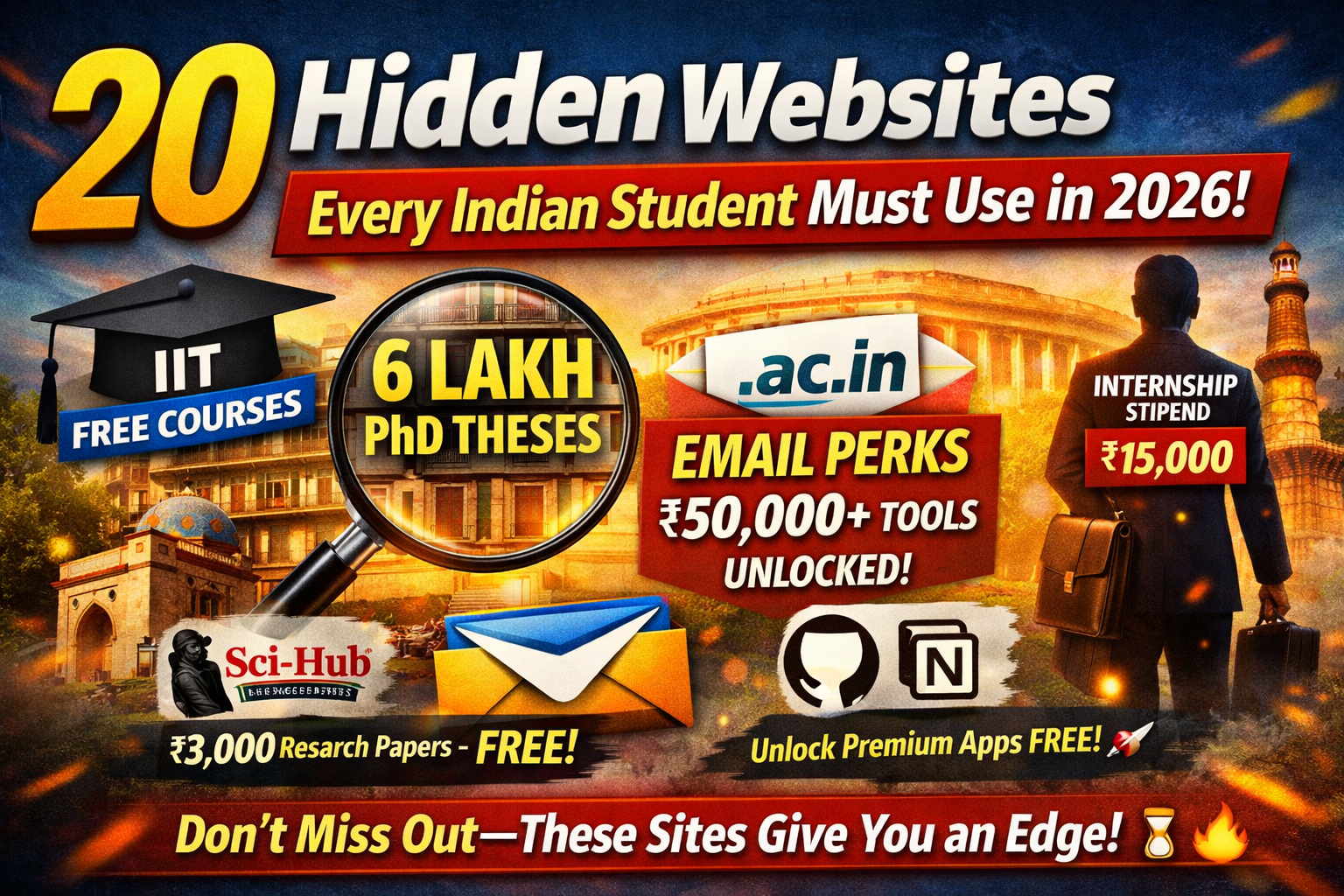
The best websites for students in India include NPTEL (2,000+ free IIT/IISc courses), Swayam (UGC credit-transferable MOOCs), Shodhganga (6+ lakh Indian PhD theses), Internshala (80,000+ internships), and Wolfram Alpha (step-by-step problem solver). Most of these are completely free and wildly underused by Indian students.
Article Summary
India has millions of students competing for the same seats, jobs, and opportunities — but very few know about the digital tools that can flip the odds in their favour. The best websites for students in India go far beyond YouTube tutorials and Wikipedia. Government-backed platforms like NPTEL, Swayam, and e-PG Pathshala offer free, credit-transferable courses taught by IIT and IISc professors. Research tools like Shodhganga and ResearchGate give postgraduate students access to lakhs of PhD theses and international journal papers — all free. Career platforms like Internshala and Unstop host 80,000+ internship listings and hundreds of competitions with real cash prizes and PPIs. Productivity tools like Notion (free for .ac.in email holders), Zotero, and Anki help students study smarter, not harder. This article lists all 20 websites with clear descriptions, use cases, and tips — giving Indian students a structured advantage from Class 9 through to postgraduation.
Section 1 — Why Most “Best Websites” Lists Fail Indian Students
Every year, thousands of articles get published listing “top educational websites.” Almost every single one recommends the same five names — YouTube, Khan Academy, Coursera, Wikipedia, and Duolingo.
There is nothing wrong with those platforms. But here is the problem: most of these lists are written for a global audience, not for Indian students.
An Indian student preparing for UPSC needs Shodhganga, not LinkedIn Learning. A Class 12 student from a Tier 3 town in Bihar needs NROER in Hindi, not a Coursera certificate that costs ₹4,000. A college student writing a research paper needs Zotero and ResearchGate, not a premium Grammarly subscription.
Why Lesser-Known Platforms Are Often Better
The websites on most top-10 lists are popular precisely because they spend heavily on SEO and marketing. That popularity does not automatically mean they are the most useful for your specific situation as an Indian student.
According to the Ministry of Education’s Annual Report 2023–24, India has over 4.33 crore students enrolled in higher education institutions. Yet only a fraction use the government-built platforms like Swayam and NPTEL — platforms funded with taxpayer money, staffed by IIT professors, and offering globally competitive content entirely free.
Pro Tip 💡: Before paying for any course or tool online, check if a government-backed Indian platform already offers it for free. In most cases, it does.
The 20 websites listed in this article were selected based on three criteria:
- Genuinely underused among Indian students (not mainstream)
- Directly India-relevant — either built for Indian syllabi or specifically valuable in the Indian context
- Free or nearly free — accessible to students across all income brackets
Section 2 — The 20 Best Websites for Students in India (Full List with Data)
The websites below are grouped by category. Each entry includes what the platform does, why it matters for Indian students specifically, and a practical use-case tip.
Category A: Free Learning & Course Platforms
1. NPTEL — nptel.ac.in
What it is: NPTEL (National Programme on Technology Enhanced Learning) is a joint initiative by IIT Bombay, IIT Delhi, IIT Kharagpur, IIT Kanpur, IIT Madras, IIT Guwahati, IIT Roorkee, and IISc Bangalore. It offers over 2,000 video-based courses across engineering, science, humanities, and management — all free.
Why it matters for Indian students: NPTEL certificates are accepted as proof of learning by hundreds of Indian companies and public sector undertakings (PSUs). According to NPTEL’s official data, over 1.4 crore students have enrolled in NPTEL courses since its launch. (Source: nptel.ac.in/about)
Use it for: Supplementing your B.Tech or BSc syllabus, preparing for GATE, or earning a certificate that impresses placement recruiters.
2. Swayam — swayam.gov.in
What it is: Swayam is India’s national MOOC (Massive Open Online Course) platform, launched by the Government of India under the Ministry of Education. It hosts over 2,000 courses from school level to postgraduate level.
Why it matters for Indian students: This is the only platform in the world where completing an online course can directly earn you university credit. Under UGC guidelines issued in 2023, students can transfer up to 40% of their degree credits through Swayam courses. (Source: ugc.gov.in)
Use it for: Reducing your college backlog pressure, earning elective credits, or learning skills recognised by your own degree programme.
3. e-PG Pathshala — epgp.inflibnet.ac.in
What it is: e-PG Pathshala is a UGC-funded e-content platform specifically designed for postgraduate students in Indian universities. It covers all major subjects taught at the PG level — from Physics to Political Science.
Why it matters for Indian students: All content is aligned to Indian university syllabi, created by subject-matter experts from UGC-approved institutions, and available in text, video, and interactive formats — 100% free.
Use it for: MA, MSc, MCom, and MCA students who need syllabus-specific study material.
4. Khan Academy — khanacademy.org
What it is: Khan Academy is a US-based non-profit platform offering free courses in Maths, Science, Computing, and Humanities for learners from Class 1 through competitive exam level. It carries zero advertisements and charges no fees — ever.
Why it matters for Indian students: Khan Academy’s Maths content maps closely to the CBSE and ICSE syllabus up to Class 12. Its JEE Mathematics prep is particularly strong. According to Khan Academy’s 2024 impact report, over 1.5 crore students in India use the platform monthly. (Source: khanacademy.org/about/impact)
Use it for: Building strong conceptual foundations in Maths and Science — something many coaching classes skip in their rush to cover syllabus.
Pro Tip 💡: Many students use Khan Academy alongside their JEE/NEET coaching to fix concept gaps that their tutor doesn’t have time to revisit. It is especially powerful for Class 11 transition when the difficulty jumps sharply.
5. NROER — nroer.gov.in
What it is: The National Repository of Open Educational Resources is a digital library of NCERT-curated educational content — videos, textbooks, interactive simulations, and audio materials for Classes 1 through 12.
Why it matters for Indian students: NROER content is available in 29 Indian languages, making it one of the few genuinely rural-friendly educational platforms in the country. All content is downloadable for offline use.
Use it for: Students in areas with limited connectivity, regional-medium learners, and teachers looking for structured classroom material.
6. Coursera (Audit Mode) — coursera.org
What it is: Coursera is a global MOOC platform hosting courses from MIT, Stanford, Google, IBM, and 300+ universities. Most students do not know that the majority of courses can be audited for free — meaning you watch all lectures and access all readings without paying.
Why it matters for Indian students: The hidden “Audit this course” link (found below the enrolment button) unlocks courses worth ₹3,000–₹10,000 for free. You do not receive the certificate unless you pay — but the learning is identical.
Use it for: Learning Python, Data Science, Digital Marketing, Machine Learning, and Business courses from globally-ranked professors at zero cost.
Category B: Research & Academic Tools
7. Shodhganga — shodhganga.inflibnet.ac.in
What it is: Shodhganga is India’s national digital repository of theses and dissertations, maintained by INFLIBNET (Information and Library Network Centre) under UGC. It hosts over 6 lakh PhD theses submitted by researchers at Indian universities.
Why it matters for Indian students: Every PhD thesis on Shodhganga contains a complete literature review — meaning it is, effectively, a free, peer-reviewed summary of all existing research in that area. For any postgraduate student writing a research paper or dissertation, this is invaluable.
Use it for: Literature reviews, finding research gaps, understanding Indian-context studies, and referencing credible academic work.
8. ResearchGate — researchgate.net
What it is: ResearchGate is a professional social network for researchers, scientists, and academics. It hosts over 160 million publication pages and allows users to directly message authors to request full-text access to their papers.
Why it matters for Indian students: Journal papers that cost ₹2,000–₹5,000 per article on publisher websites can often be obtained free by simply clicking “Request full-text” on ResearchGate — the author emails you the PDF directly, usually within 48 hours.
Use it for: PG and PhD students needing access to specific journal articles without institutional journal subscriptions.
9. Sci-Hub — sci-hub.se
What it is: Sci-Hub is an online repository that provides free access to millions of research papers and books, regardless of copyright restrictions. It is widely used by researchers globally — including at institutions that cannot afford expensive journal subscriptions.
Why it matters for Indian students: India’s smaller universities and colleges often lack access to JSTOR, Elsevier, Springer, and other major journal databases. Sci-Hub levels the playing field by making the same research available to a student in a Tier 3 college as to one at IIT Delhi.
Use it for: Accessing specific journal articles by pasting the DOI (Digital Object Identifier) into the search bar.
⚠️ Note: Sci-Hub operates in a legally contested space globally. Check the current status of access in your region before use.
10. Zotero — zotero.org
What it is: Zotero is a free, open-source reference management software that automatically collects, organises, cites, and generates bibliographies from web sources, PDFs, and databases.
Why it matters for Indian students: Any student writing a thesis, dissertation, or research paper manually manages citations at enormous cost of time and error. Zotero eliminates this entirely — it formats citations in APA, MLA, Chicago, and hundreds of other styles automatically.
Use it for: Research papers, dissertations, literature reviews, and any academic writing that requires citations.
Category C: Exam Preparation Platforms
11. ClearIAS — clearias.com
What it is: ClearIAS is one of India’s most comprehensive free UPSC Civil Services preparation websites, offering free study materials, previous year question papers, mock tests, current affairs summaries, and mind maps for both Prelims and Mains.
Why it matters for Indian students: A full UPSC coaching programme in Delhi costs ₹1.5 lakh to ₹3 lakh. ClearIAS provides structured, high-quality guidance entirely free — used by thousands of IAS/IPS officers who have cleared the exam.
Use it for: UPSC aspirants at every stage of preparation — from beginners understanding the exam pattern to advanced students practising Mains answers.
12. IndiaBix — indiabix.com
What it is: IndiaBix is a free MCQ practice platform covering Quantitative Aptitude, Logical Reasoning, Verbal Ability, General Knowledge, and Technical subjects across hundreds of topics.
Why it matters for Indian students: Nearly every major Indian placement test — TCS, Infosys, Wipro, Accenture, government bank exams, GATE — tests aptitude in some form. IndiaBix has the largest freely accessible Indian aptitude question bank online.
Use it for: Campus placement preparation, banking exams (SBI PO, IBPS), GATE, SSC CGL, and any exam with an aptitude section.
13. PhysicsWallah Free Tier — pw.live
What it is: PhysicsWallah (PW) is India’s fastest-growing edtech platform, but most students don’t know that the PW website’s free content tier includes thousands of JEE, NEET, and board exam videos, DPP (Daily Practice Problems) PDFs, and topic-wise notes — without purchasing any course.
Why it matters for Indian students: PW’s paid courses are affordable by edtech standards, but the free content alone rivals many platforms’ paid offerings. According to PW’s investor disclosures, the platform serves over 10 crore registered learners as of 2025. (Source: PW Annual Report 2025)
Use it for: JEE Mains and Advanced, NEET UG, Class 11–12 boards, and concept videos for Physics, Chemistry, Maths, and Biology.
Category D: Career & Internship Platforms
14. Internshala — internshala.com
What it is: Internshala is India’s largest internship and fresher jobs platform, with over 80,000 active internship listings at any given time across engineering, marketing, design, finance, and content domains. Many internships offer stipends ranging from ₹5,000 to ₹25,000 per month.
Why it matters for Indian students: Internshala also runs free certified online training programmes in Python, Data Science, Digital Marketing, Machine Learning, and more. These certificates are recognised by thousands of Indian employers.
If you want to build job-ready skills while searching for internships, Internshala Training offers structured courses with projects and certificates — [AFFILIATE LINK PLACEHOLDER]. Many are available for free during their promotional windows.
Use it for: Finding internships, building your resume, and getting certified in industry-relevant skills.
15. Unstop — unstop.com
What it is: Unstop (formerly Dare2Compete) is India’s leading platform for student competitions — hackathons, case study competitions, business plan contests, coding challenges, and quizzes. It hosts competitions from IIMs, IITs, top MNCs, and startups.
Why it matters for Indian students: Winning or even participating in competitions on Unstop directly leads to Pre-Placement Interview (PPI) and Pre-Placement Offer (PPO) opportunities at top companies. Cash prizes range from ₹10,000 to ₹5 lakh per competition.
Use it for: Building your resume, winning scholarships, earning PPIs from top companies, and standing out in campus placements.
16. Job Hai — jobhai.com
What it is: Job Hai is a job platform specifically focused on first-job and blue-collar opportunities in Tier 2 and Tier 3 Indian cities. Unlike Naukri or LinkedIn, it has a Hindi-language interface and specifically caters to freshers in non-metro locations.
Why it matters for Indian students: Approximately 65% of India’s student population lives outside the top 10 cities. Most job platforms are designed for metro professionals. Job Hai addresses this gap directly.
Use it for: Students from smaller cities looking for local employment, first jobs, and internships without relocating.
Category E: Productivity & Study Tools
17. Wolfram Alpha — wolframalpha.com
What it is: Wolfram Alpha is a computational knowledge engine — not a search engine. It solves mathematical problems step-by-step, explains chemistry reactions, analyses statistical data, computes financial formulas, and answers factual queries using structured databases.
Why it matters for Indian students: For JEE, GATE, or any technical exam, Wolfram Alpha can solve integration, differentiation, matrix operations, and chemical equations with full working steps shown — completely free.
Use it for: Verifying your Maths and Science problem-solving steps, learning from solved examples, and understanding where your method went wrong.
18. Notion (Student Plan) — notion.so/students
What it is: Notion is an all-in-one productivity and note-taking platform. Students with a verified .ac.in or .edu email get the Notion Plus plan completely free — a plan that costs ₹1,600/month for general users.
Why it matters for Indian students: Notion allows students to build a complete personal knowledge base — notes, assignment trackers, reading lists, project management boards, and collaborative documents — all in one place.
Notion’s free student plan is one of the most underused perks in Indian higher education. If your college email ends in .ac.in, activate it today at notion.so/students → [AFFILIATE LINK PLACEHOLDER]
Use it for: Semester planning, group project management, research note-taking, and building a personal productivity system.
19. Anki — apps.ankiweb.net
What it is: Anki is a free, open-source flashcard application built on spaced-repetition science — a learning method proven by cognitive psychology research to dramatically improve long-term retention of information.
Why it matters for Indian students: Medical students preparing for NEET PG, USMLE, and clinical exams globally swear by Anki. According to published cognitive science research, spaced-repetition-based review can improve long-term recall by up to 200% compared to passive re-reading. (Source: Ebbinghaus Forgetting Curve Research — Cepeda et al., 2008, Psychological Bulletin)
Use it for: NEET UG/PG, language learning, vocabulary building, and memorising large volumes of factual content for any competitive exam.
20. Percipio by Skillsoft — percipio.com
What it is: Percipio is an AI-driven learning platform by Skillsoft offering thousands of courses in Technology, Business, and Leadership. Many Indian universities and AICTE-approved institutions provide free institutional access to Percipio for their students.
Why it matters for Indian students: Most students don’t know their college ID may already unlock premium content. AICTE has partnered with Skillsoft to provide access to engineering students across India. Check with your college library or IT department.
Use it for: Tech skill development (cloud, cybersecurity, coding), soft skills, and professional certification preparation.
Section 3 — How to Use These Websites Based on Your Goal
Different students need different tools. Here is a structured guide:
| Your Goal | Best Websites to Use |
|---|---|
| JEE / NEET Preparation | Khan Academy, PhysicsWallah Free Tier, IndiaBix, Wolfram Alpha |
| UPSC Preparation | ClearIAS, Shodhganga, Swayam, NROER |
| Writing a Research Paper | Zotero, Shodhganga, ResearchGate, Sci-Hub |
| Getting an Internship | Internshala, Unstop, Job Hai |
| Free Degree-Level Courses | NPTEL, Swayam, e-PG Pathshala, Coursera (Audit) |
| Productivity & Organisation | Notion (Student Plan), Anki, Zotero |
| Skill Certifications | NPTEL, Internshala Training, Percipio |
| Rural / Regional Language | NROER (29 languages), Swayam (Hindi medium courses) |
Section 4 — The .ac.in Email Advantage Most Students Ignore
Your college-issued email ending in .ac.in or .edu.in is not just for receiving assignment emails from professors. It is a master key that unlocks hundreds of premium tools for free.
Here is what your Indian college email unlocks as of 2026:
| Platform | What You Get Free | Normal Price |
|---|---|---|
| Notion | Plus Plan (unlimited pages, collaboration) | ₹1,600/month |
| GitHub | GitHub Pro + Copilot for Students | ₹800/month |
| JetBrains | All IDEs (IntelliJ, PyCharm, WebStorm) | ₹3,500/year |
| Microsoft Azure | Azure for Students ($100 credits) | ₹8,000+ |
| Canva | Canva Pro | ₹3,999/year |
| Figma | Professional Plan | ₹3,800/month |
| Autodesk | AutoCAD, Maya, Fusion 360 | ₹50,000+/year |
According to GitHub’s Education programme data, over 5 lakh Indian students have activated GitHub Student Developer Pack — but this still represents only a fraction of eligible students. (Source: education.github.com)
Action step: Go to github.com/education, verify your student status with your college ID card and .ac.in email, and activate the GitHub Student Developer Pack today.
Section 5 — Common Myths Indian Students Believe About Free Online Resources
Millions of Indian students avoid these free platforms because of myths spread in WhatsApp groups and by coaching centre marketing teams. Let us bust the biggest ones.
Myth 1: “Free Courses Are Not Taken Seriously by Employers”
Busted. NPTEL certificates are explicitly listed as preferred qualifications by companies like L&T, Tata Steel, BHEL, Indian Oil, and numerous PSUs in their official job notifications. According to NPTEL’s official placement data, students with 2–3 NPTEL certifications see measurably higher shortlisting rates in core engineering companies.
The certificate’s value comes from which platform issued it and the quality of assessment. NPTEL’s proctored exams are taken at designated exam centres and carry genuine academic weight.
Myth 2: “I Need a Fast Internet Connection to Use These Platforms”
Busted. NROER allows full offline downloads in 29 languages. NPTEL videos are available for download. Anki works entirely offline. Khan Academy has an offline app. Swayam courses can be downloaded week-by-week.
India’s internet penetration reached 93.6 crore subscribers as of December 2024 (Source: TRAI Telecom Subscription Data, December 2024), but data costs can still be a concern in rural areas. All the platforms listed above have been designed with low-bandwidth or offline access in mind.
Myth 3: “Only Metro Students Benefit From These Platforms”
Busted. NROER is specifically designed for regional-medium students. Swayam runs courses in Hindi, Tamil, Telugu, Bengali, and other Indian languages. Job Hai is built for Tier 2/3 city job seekers. PhysicsWallah’s founding story — Alakh Pandey teaching from Allahabad for students who could not afford coaching — is proof that these platforms were built specifically for non-metro India.
Myth 4: “I Can Just Google Everything — I Don’t Need These Tools”
Busted. Google Search returns SEO-optimised marketing content. It does not return a 300-page PhD thesis on your exact research topic, a structured UPSC mock test, or a step-by-step integral solution with working shown. Each tool on this list does something Google Search cannot.
Section 6 — Pro Tips for Getting Maximum Value from These Platforms
Getting the most out of these platforms requires a system, not just a signup.
Tip 1: Build a Weekly Study Stack
Do not try to use all 20 platforms simultaneously. Build a personal “study stack” of 3–5 tools that match your current goal. Review and rotate your stack every semester.
Tip 2: Combine NPTEL + Swayam for Degree Credit
NPTEL courses integrate with Swayam’s credit-transfer mechanism. If you complete a NPTEL course and pass the proctored exam, you may be eligible to claim elective credits in your degree. Check UGC Circular No. F.1-1/2021 (online) dated August 2021 for the official credit transfer guidelines.
Tip 3: Use Zotero + Shodhganga + ResearchGate Together
This trio forms a complete research workflow for Indian postgraduate students:
- Search for thesis topics on Shodhganga
- Find related international papers on ResearchGate
- Organise, cite, and generate bibliography automatically with Zotero
Tip 4: Stack Competition Wins on Unstop for Placement Season
Recruiters at top companies specifically look for Unstop/Dare2Compete participation on resumes. Three or more competition participations — even without winning — demonstrate initiative, teamwork, and domain knowledge that generic resumes lack.
Tip 5: Activate All .ac.in Perks Before Your Final Year
Most students activate GitHub or Notion in their final year — too late to get the full benefit. Activate all .ac.in perks in Semester 1 of your first year and use them throughout your degree.
Section 7 — FAQ: People Also Ask
Which is the best free website for students in India to learn coding?
The best free websites for learning coding in India are NPTEL (for structured university-level programming courses in C, Python, Java, and Data Structures), Khan Academy (for beginners), and Coursera in audit mode (for Google, IBM, and Meta professional certificates). For placement-focused coding, IndiaBix covers technical MCQs while platforms like HackerRank offer practice problems. All of these are free with no registration fees.
Are NPTEL certificates free and valid in India?
Yes. NPTEL certificates are completely free to earn at the basic level. You pay a small exam fee (approximately ₹1,000) to appear for the proctored certification exam — but the course itself is free. NPTEL certificates are widely accepted by Indian PSUs, engineering firms, and corporate employers. According to NPTEL’s official website, over 1.4 crore students have enrolled since its launch. (Source: nptel.ac.in/about)
What is the best website for UPSC preparation in India for free?
ClearIAS (clearias.com) is considered one of the best free UPSC preparation resources online. It offers structured study materials for Prelims and Mains, previous year papers, mock tests, current affairs compilations, and concept mind maps — all free. Additionally, Shodhganga is invaluable for UPSC Optional subject preparation as it contains thousands of research theses on Indian history, geography, public administration, and more.
How can Indian students access research papers for free?
Indian students can access research papers for free through three main channels: (1) Shodhganga for Indian PhD theses, (2) ResearchGate by requesting full-text PDFs directly from authors, and (3) Sci-Hub for international journal articles by pasting the paper’s DOI. Additionally, students whose colleges have INFLIBNET’s N-LIST subscription can access thousands of journals through the INFLIBNET portal at inflibnet.ac.in.
Does Notion give a free plan to Indian college students?
Yes. Notion offers its Plus Plan free to students who verify their student status with a .ac.in or .edu email address. The Plus Plan normally costs approximately ₹1,600 per month and includes unlimited blocks, unlimited file uploads, and collaboration features. Students can activate this at notion.so/students by verifying with their institutional email.
What is Swayam and how is it different from Coursera?
Swayam (swayam.gov.in) is India’s government-run MOOC platform launched by the Ministry of Education. The key difference from Coursera is that Swayam courses are eligible for university credit transfer under UGC guidelines — meaning completing certain Swayam courses can count toward your actual degree. Coursera courses, while globally recognised, do not directly count toward Indian university degrees. Swayam is also entirely free, while Coursera charges for certificates.
Conclusion
India is full of students working extremely hard but using outdated or overpriced tools when better — and free — alternatives already exist.
The best websites for students in India are not hidden. They are underpublicised. NPTEL, Swayam, Shodhganga, ClearIAS, Internshala, and the 15 other platforms listed here were built with Indian students in mind — many by the Government of India itself, using public funds.
The three most important takeaways from this article:
- Government platforms (NPTEL, Swayam, e-PG Pathshala, NROER) are world-class, free, and embarrassingly underused by the students they were built for.
- Your .ac.in email unlocks thousands of rupees worth of premium tools — most students never claim these benefits.
- A combination of Zotero + Shodhganga + ResearchGate gives any Indian postgraduate student access to research tools equivalent to what students at the world’s top universities use.
Bookmark this article, share it with one classmate who doesn’t know about these platforms, and check out our related guides below.
© 2026 IndiaBrief. All rights reserved. indiabrief.me Last Updated: March 17, 2026 | Written by IndiaBrief Team