
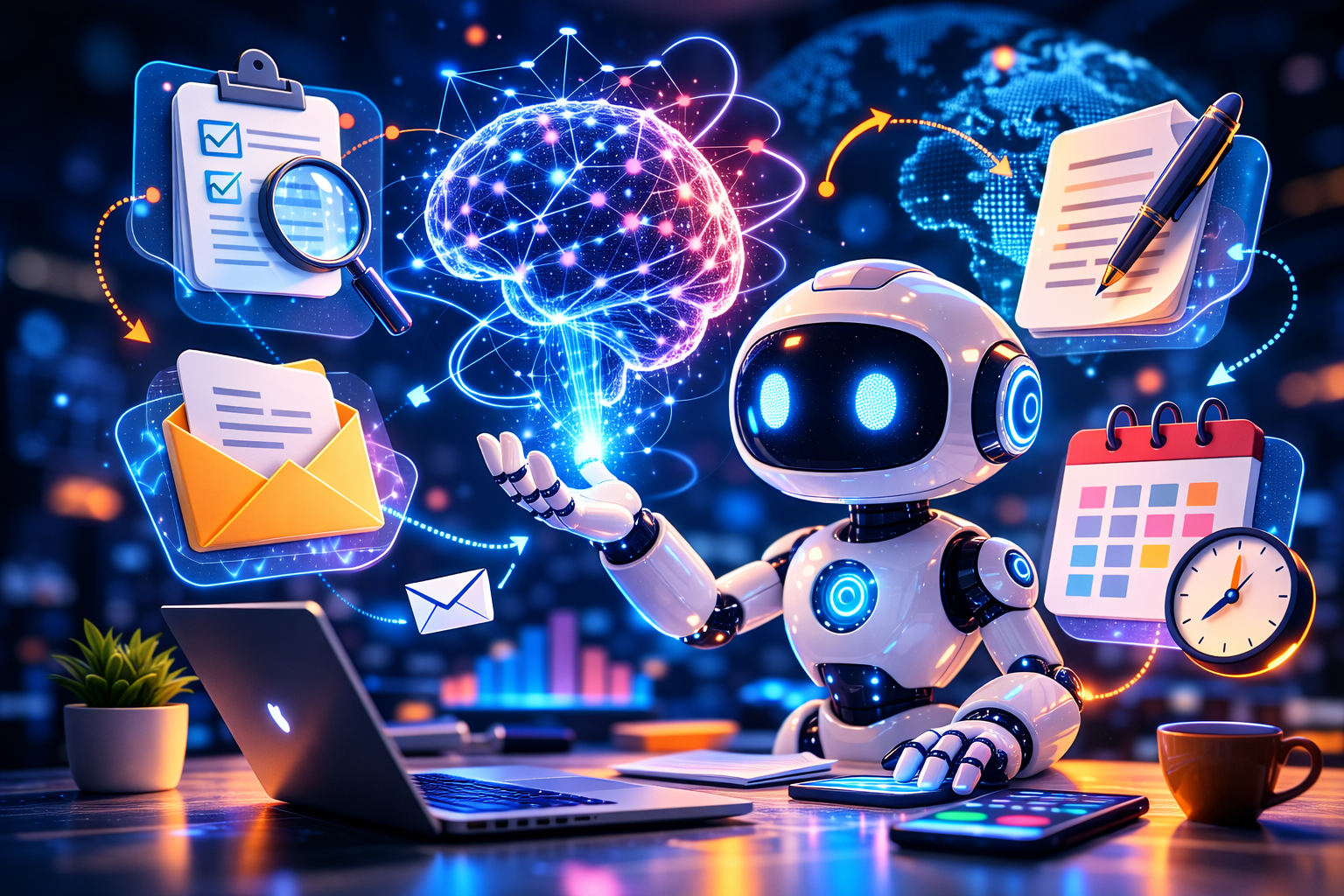
Quick Answer: Agentic AI refers to artificial intelligence systems that can set their own goals, plan multi-step tasks, take actions, and complete complex work — all without needing human instructions at every step. Unlike ChatGPT, which waits for your prompts, an AI agent acts on its own to get a job done from start to finish.
You have been hearing the term “Agentic AI” everywhere. On LinkedIn. In tech news. Even at your office. But nobody is explaining what it actually does in plain language.
Here is the truth: agentic AI is already changing how companies hire, how apps work, and how everyday tasks get done — and most people haven’t even noticed yet.
According to Gartner, 40% of enterprise applications will include task-specific AI agents by the end of 2026 — up from less than 5% just one year ago. That is one of the fastest adoption rates any technology has ever recorded.
In this article, you will learn exactly what agentic AI is, how it is different from tools you already use like ChatGPT, real-world examples you can relate to, and how you can start using it today — even if you have zero technical knowledge.
Let’s break it down simply.
Article Summary
Agentic AI is a new generation of artificial intelligence that goes beyond answering questions — it autonomously plans, decides, acts, and self-corrects to complete entire workflows with minimal human involvement. Unlike generative AI tools such as ChatGPT (OpenAI) or Gemini (Google), which respond to prompts one at a time, agentic AI breaks a complex goal into sub-tasks, executes them in sequence, checks the quality of each step, and adjusts its approach if something goes wrong. The global agentic AI market was valued at approximately USD 7.6 billion in 2025 and is projected to exceed USD 10.9 billion in 2026 (Source: Grand View Research). Major players driving this space include Microsoft Corporation, Google LLC, Amazon Web Services (AWS), NVIDIA Corporation, and Anthropic. India is one of the fastest-growing adopters — over 80% of Indian organisations are actively exploring autonomous AI agents, according to Deloitte’s State of GenAI report.
So, What Exactly is Agentic AI?
Think about the last time you used ChatGPT. You typed a question. It gave you an answer. You typed another question. It gave another answer. Every single step required you to guide it.
Now imagine instead of that, you say: “Research the top 5 competitors in my industry, write a comparison report, format it as a PDF, and email it to my manager.”
And the AI just… does all of that. On its own. Without you having to hand-hold it through each step.
That is agentic AI.
Formal Definition: What is Agentic AI?
Agentic AI is an artificial intelligence system that exhibits autonomous decision-making, goal-directed behaviour, and long-term planning — similar to how a human agent would act. These systems perceive information from their environment, reason through complex problems, plan a sequence of actions, execute those actions using tools, and self-correct when they make errors. (Source: Precedence Research, 2026)
The Three Superpowers of an AI Agent
Every agentic AI system has three core abilities that normal AI tools do not:
- Autonomy — It operates independently without requiring step-by-step human supervision.
- Goal-orientation — It pursues a specific objective and keeps working until it achieves it.
- Self-correction — If one step fails or gives a wrong result, it detects the problem and tries a different approach.
Pro Tip: A simple way to remember it: Regular AI = a calculator that answers when you press a button. Agentic AI = a smart assistant who picks up your to-do list, figures out how to complete each task, and brings you the finished result.
Takeaway: Agentic AI is not just a smarter chatbot — it is an autonomous digital worker.
How is Agentic AI Different from ChatGPT?
This is the most common question, and it deserves a clear, honest answer.
ChatGPT, Google Gemini, and similar tools are examples of Generative AI (GenAI). They are powerful, but they are fundamentally reactive — they wait for your input, generate a response, and stop. They have no memory of your previous sessions. They take no action in the real world. They cannot open your email or browse a website unless you specifically build that in.
Agentic AI, on the other hand, is proactive. It can use tools, remember past context, take real-world actions (like browsing the web, writing code, sending emails), and persist over time until a goal is complete.
Side-by-Side Comparison Table
| Feature | Generative AI (e.g. ChatGPT) | Agentic AI |
|---|---|---|
| Works when | You send a prompt | Given a goal once |
| Memory | None between sessions | Persistent context |
| Takes real actions | No | Yes (web, email, files) |
| Multi-step tasks | Needs human input each step | Plans & executes all steps |
| Self-corrects errors | No | Yes |
| Example | Write me a blog post | Research, write, format & publish a blog post |
Can ChatGPT Become Agentic?
Yes — partially. Tools like ChatGPT Plus (OpenAI) and Claude.ai Pro (Anthropic) are adding agentic features such as browsing, code execution, and memory. These are early steps toward full agentic behaviour. However, purpose-built agentic platforms like AutoGPT, CrewAI, and Microsoft’s AutoGen framework go much further in autonomous task execution.
Takeaway: ChatGPT answers your questions. Agentic AI completes your projects.
Real-Life Examples of Agentic AI in Action
Forget the theory. Here is what agentic AI actually looks like in real life, right now in 2026.
Example 1: Customer Service That Never Sleeps
A customer messages a company at 2 AM asking for a refund. An agentic AI agent reads the complaint, checks the order history in the company database, verifies the refund policy, processes the refund, sends a confirmation email — and logs the case. No human involved. Case closed in under 2 minutes. (Source: Gartner, 2026 — AI agents projected to autonomously resolve 80% of common customer service issues by 2029.)
Example 2: Your Personal Research Assistant
Imagine telling an AI agent: “Find me the top 10 government jobs opening in March 2026, check their eligibility, and create a tracker spreadsheet with deadlines.” The agent searches official portals, extracts data, builds the spreadsheet, and shares it with you — in minutes.
Example 3: Marketing on Autopilot
A startup founder tells their AI agent: “Post 3 times a week on LinkedIn using content from our blog.” The agent reads new blog posts, rewrites them for LinkedIn, schedules the posts, monitors engagement, and adjusts content style based on what performs best. All automatically.
Real Industry Numbers
According to Master of Code Global’s 2026 AI statistics analysis:
- 61% of businesses using agentic AI report greater staff efficiency. (Source: Master of Code Global, 2026)
- 56% report cost reductions after deploying AI agents. (Source: Master of Code Global, 2026)
- Siemens achieved 90% touchless processing across industrial workflows using multi-agent AI systems, realising EUR 5 million in annual savings. (Source: Mordor Intelligence, 2026)
Takeaway: Agentic AI is not science fiction — millions of businesses are using it right now.
Why Everyone is Talking About Agentic AI in 2026
The numbers tell a clear story.
The Market is Exploding
- The global agentic AI market was valued at USD 7.6 billion in 2025 and is projected to exceed USD 10.9 billion in 2026. (Source: Grand View Research)
- By 2033, the market is expected to reach USD 182.97 billion, growing at a CAGR of 49.6%. (Source: Grand View Research)
- 96% of enterprises are expanding their use of AI agents. (Source: Market.us Report, January 2026)
- 83% of executives consider investment in agentic AI essential to remain competitive. (Source: Market.us Report, January 2026)
India is Right in the Middle of This
India is not just watching this revolution — it is participating.
According to Deloitte’s State of GenAI report (India perspective), over 80% of Indian organisations are actively exploring the development of autonomous AI agents. This is a major strategic shift happening in boardrooms across Mumbai, Bangalore, Hyderabad, and Delhi right now.
The Asia-Pacific region is projected to grow at the fastest CAGR of 44.95% through 2031, driven largely by India, Singapore, and Japan. (Source: Mordor Intelligence, 2026)
Why 2026 is the “Inflection Point”
Three major changes happened simultaneously:
- Protocol standardisation — Anthropic’s Model Context Protocol (MCP) and Google’s Universal Commerce Protocol (UCP) created shared standards for how agents communicate.
- Cost dropped dramatically — Running an AI agent now costs a fraction of what it did in 2024.
- Tools became beginner-friendly — You no longer need to be an engineer to deploy an AI agent.
Takeaway: The agentic AI wave is not coming — it is already here, and India is one of the fastest-growing markets.
Best Agentic AI Tools You Can Try Right Now
You do not need to be a developer to start using agentic AI. Here are the best tools for complete beginners in 2026.
Beginner Tools (No Coding Required)
| Tool | Best For | Price |
|---|---|---|
| Zapier AI | Automating repetitive work tasks | Free plan available |
| Notion AI | Managing projects, notes & research autonomously | ₹800/month approx |
| Claude.ai Pro (Anthropic) | Complex research, writing & multi-step tasks | ₹1,600/month approx |
| ChatGPT Plus (OpenAI) | General agentic tasks with browsing | ₹1,700/month approx |
| Make (Integromat) | Connecting apps and automating multi-step workflows | Free plan available |
Which Tool Should You Start With?
If you are a student or freelancer just starting out, Zapier AI is the best first step — it lets you automate tasks between apps you already use (Gmail, Google Sheets, WhatsApp) without writing a single line of code.
If you do a lot of research or writing, Claude.ai Pro (built by Anthropic) is highly rated for its ability to follow long, complex instructions and complete multi-step tasks reliably. It is currently one of the strongest agentic writing and research tools available.
Takeaway: You can start using agentic AI today — no technical background needed.
Is Agentic AI Dangerous? What You Should Know
This is a fair and important question. Let us be honest about both sides.
What Could Go Wrong?
- Errors at scale — If an AI agent makes a wrong assumption in Step 1, it might compound that error through all 10 subsequent steps before anyone notices.
- Privacy concerns — Agents that access your email, files, and browser history raise real data security questions.
- Job displacement — Research by McKinsey suggests that roles involving repetitive, rule-based tasks are most at risk of automation.
- Lack of oversight — As of 2026, human-in-the-loop oversight remains standard — most organisations keep a human reviewing agent decisions. (Source: Salesmate/Grand View Research, 2026)
What Safeguards Exist?
- Gartner warns that over 40% of agentic AI projects are at risk of failure by 2027 if governance and observability standards are not established. Companies are taking this seriously.
- Most enterprise agentic AI systems include approval checkpoints — the agent pauses and asks a human before taking irreversible actions (like sending an email or making a payment).
- Major platforms like Microsoft, Google, and Anthropic are building mandatory safety layers into their agentic systems.
The Honest Answer
Agentic AI is a powerful tool that carries real risks — just like cars, the internet, or any major technology. Used with proper oversight and clear boundaries, it dramatically increases productivity. Used carelessly, it can cause serious errors. The key is starting small, staying informed, and keeping humans in the loop for high-stakes decisions.
Takeaway: Agentic AI is powerful and comes with real risks — smart use means keeping humans involved in critical decisions.
How to Prepare Yourself for the Agentic AI Era
Whether you are a student, a job seeker, or a working professional, here is exactly what you should do right now.
Step-by-Step Preparation Guide
Step 1 — Understand the basics (this week) Read this article. Understand what agentic AI does. You are already doing this.
Step 2 — Experiment with one tool (this month) Pick Zapier AI or Claude.ai Pro and try automating one real task in your daily life. Even something small — like summarising your inbox every morning.
Step 3 — Learn prompt engineering The quality of instructions you give an AI agent determines the quality of output. Learning “prompt engineering” (how to write clear, detailed instructions for AI) is one of the most valuable skills of 2026. Udemy and Coursera both have free beginner courses.
Step 4 — Follow the AI news The space is changing every month. Subscribe to newsletters like The Rundown AI or follow IndiaBrief’s Technology section for India-specific AI updates.
Step 5 — Update your resume Adding “familiar with agentic AI tools” or listing tools like Zapier AI or Notion AI on your CV is already making candidates stand out in tech, marketing, and operations job applications.
Takeaway: The best time to start learning about agentic AI was last year. The second best time is right now.
Common Myths About Agentic AI — Busted
Myth 1: “Agentic AI will replace all jobs immediately”
Reality: As of 2026, agentic AI is augmenting jobs far more than replacing them. Most deployments assist humans with repetitive work, freeing them for higher-value tasks. 83% of executives believe AI agents will outperform humans only in repetitive, rule-based tasks — not creative or strategic work. (Source: Master of Code Global, 2026)
Myth 2: “You need to be a programmer to use AI agents”
Reality: Modern tools like Zapier AI, Notion AI, and Make are built for non-technical users. Millions of Indian professionals are using them today with zero coding knowledge.
Myth 3: “Agentic AI is always right”
Reality: AI agents make mistakes — especially when given ambiguous instructions or incomplete data. Always review outputs for high-stakes tasks. This is exactly why “human-in-the-loop” design is now an industry standard.
Myth 4: “It’s only for big companies”
Reality: The rise of affordable, cloud-based agent tools means freelancers and small businesses now have access to the same automation power as Fortune 500 companies. The playing field has levelled significantly in 2026.
Frequently Asked Questions
What is agentic AI in simple words?
Agentic AI is a type of artificial intelligence that can take actions, make decisions, and complete multi-step tasks on its own — without needing human instructions at every stage. Think of it like a smart virtual assistant who you give a goal to, and it figures out all the steps to get there by itself, using available tools like the internet, email, or software apps.
What is the difference between agentic AI and generative AI?
Generative AI (like ChatGPT or Google Gemini) creates content — text, images, code — when you give it a prompt. Agentic AI goes further: it can plan a sequence of tasks, execute them using real tools, check the results, and self-correct errors — all with a single goal given upfront. Generative AI is reactive. Agentic AI is proactive and action-oriented.
What are some examples of agentic AI tools in 2026?
Popular agentic AI tools in 2026 include Zapier AI (workflow automation), Notion AI (project and research management), Claude.ai Pro by Anthropic (complex research and writing tasks), ChatGPT Plus by OpenAI (multi-step tasks with browsing), Microsoft Copilot (integrated across Microsoft 365 applications), and CrewAI (multi-agent orchestration for developers). Many of these tools have free tiers suitable for beginners.
Is agentic AI safe to use?
Agentic AI is generally safe when used with proper oversight. As of 2026, most enterprise deployments include human-in-the-loop checkpoints — meaning the AI pauses and asks for human approval before taking irreversible actions. Gartner warns that projects without clear governance and observability risk failure by 2027. For personal use, always review agent outputs and avoid giving agents access to sensitive accounts without understanding the permissions involved.
How big is the agentic AI market in 2026?
The global agentic AI market is projected to exceed USD 10.9 billion in 2026, up from approximately USD 7.6 billion in 2025, according to Grand View Research. The market is growing at a CAGR of approximately 49.6% and is expected to reach USD 182.97 billion by 2033. India, along with Singapore and Japan, is driving the fastest growth in the Asia-Pacific region.
Can agentic AI help Indian students and job seekers?
Yes — significantly. Indian students and job seekers can use agentic AI tools to automate job application research, track government job deadlines, build resumes, summarise study material, and practice interview questions. Over 80% of Indian organisations are already exploring AI agents internally (Source: Deloitte, 2026), meaning familiarity with these tools will be a strong hiring advantage in the near future.
Conclusion
Agentic AI is not just another tech buzzword. It is the most significant shift in how software works since the smartphone — and it is happening right now, in 2026, at a pace that is genuinely difficult to keep up with.
The three things to remember: First, agentic AI can plan and complete entire projects on its own — it is a digital worker, not just a chatbot. Second, it is already being used by 96% of expanding enterprises worldwide, with India among the fastest-growing adopters. Third, you can start using beginner-friendly tools like Zapier AI or Claude.ai Pro today, with no technical background required.
Your action: Bookmark this article, share it with a friend who is curious about AI, and explore one agentic AI tool this week. The future of work is being written right now — and it is written by people who start early.
Check out IndiaBrief’s Technology section for more articles like this, updated every week.